
SMS
Equine and Canine How it works
Equine and Canine How it works
I do not sell saddles. I am not tied to any brand, so my advice is always independent and focused entirely on what is right for you and your horse. The problem I saw was that independent fitting and support to find a saddle within budget did not exist. I trained in saddle fitting to provide the service that owners and riders were missing.
In my equine bodywork services, I work on the musculoskeletal structure itself. A saddle sits directly on that structure, so the two are constantly interacting and influencing each other. A poor fit affects muscle development, and an imbalance in the muscle affects how the saddle sits. My approach to saddlefitting is unique, but the combination of my bodywork and saddlefitting offers a "whole horse" approach to your horse's wellbeing and performance.
I care about a preventative, evidence based approach, not just reacting once something has already gone wrong. For horses, the saddle is one of the most significant aspects. For dogs, the physical challenges are more often breed related, including joint problems, arthritis, trauma and post surgical rehab. The clinical research is clear on how much difference early support can make, and that is what I centre my practice around.
My approach brings all of this together. Independent fitting, bodywork, and a preventative mindset to help you look after the animals you care about, and optimise performance in sport.
To skip the information on my approach, and jump straight to what McTimoney Animal Therapy is, or why you should choose a Society of Master Saddlers saddle fitter, and get answers to commonly asked questions, click the buttons to jump down the page. To find out more about my background and qualifications please see the About page.
While many people do purchase brand new saddles, there is a group of horse owners who either use existing saddles, with padding or flocking solutions, or purchase second hand.
New "branded" or "custom" saddles are generally sold by reps, who are all trained by their brands but not all are Society trained and the training differs between brands.
Independent fitters but those who sell new saddles work with a subset of brands, and again like reps can only sell the saddles from their brand, or their 2nd hand stock from other brands.
No matter how skilled, experienced and qualified they are many cannot afford a "new" saddle, or are limited by the reps available.
As consumer, you are put in a position of either buying a "new" saddle from someone you choose, but being limited on brand and style, or vice versa. You may also find you get conflicting or varied advice from brand suppliers.
For fitters and saddleries, second hand saddles are hard to manage as stock, and hard to sell. New saddles can be made on order, there are less risks with repairs and issues, and better margin when running a business- which is critical!
It is very obvious that the industry puts fitters in a tricky position, and the costs of carrying the range required, managing second hand saddles, travel etc is hard!
Add into this that the business of saddle fitting, has a lot less profit than saddle sales with a lot more travel, and it's resulted in the position we see today.
There are fewer and fewer saddle fitters serving the second hand market. Saddle fitting for existing saddles is limited - often to the person you purchased the saddle from, which can be tricky when you move or the fitter is no longer available.
To put this into context, my own story is a great case study.I grew up around an excellent saddle fitter, a trusted family friend, and watched friends struggle with expensive, difficult saddle problems. Then it happened to me.
I found myself with a tricky shaped horse, away from my usual saddle fitter, and without the budget to buy new. I tried saddlery shops and Facebook marketplace. I went through six different saddles, none of which worked, while the horse had a lovely time on the long reins. The advice I had was significantly different between all of the different professionals, and that is what led me to look into what Society of Master Saddlers training actually meant, and why it made such a difference.
I was left with the same choice so many owners face: make do with something that is not right, or spend a fortune, because your horse's wellbeing always comes before the budget. Another case example that resonated with me, was someone who had a saddle loaned to her when she took on her new horse. All she needed was help finding the same fit and style, as affordably as possible. That service was simply not there for her. Without it, she ended up paying far more than she needed to, and the horse paid the price as a result of the new saddle not fitting as it should have, causing injury and time off.
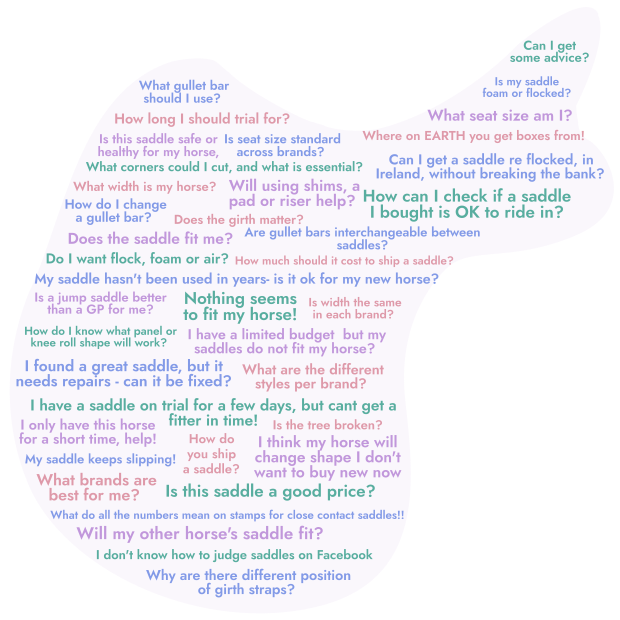
These experiences are not isolated and I built up a picture - like the phrases in this word cloud. I have asked many myself, hear them again and again from other owners. If any of them sound familiar, my services are designed for you.
If you have ever experienced something similar, or heard your own questions in what you just read, my services can help. My saddle work is built for three types of client.
Clients who want a "new" to them saddle, but not a brand new brand saddle. They may want some or all of- support to assess their horse, what to search for, advice on adverts, options and shipping, and help to quality check and fit trial or purchased saddles.


Clients who have saddles at home, but may have various horses, or horses who change shape across the year, and want support and advice on how to best manage the comfort and performance of their horses by having a well fitted saddle.


Clients who need repairs on existing or newly purchased ( not brand new) saddles, to ensure a longer life, and a healthier fit for them and the horse.


Before I decided to train as a saddle fitter, I had already started my animal therapy journey. I chose to study Animal Therapy ahead of my current Masters in Animal Chiropractic, not as a stepping stone, but because I value what it lets me do in its own right.
I bring an academic discipline to my approach, engaging directly with veterinary research, to ensure I am bringing you the latest developments in the field. There is considerable evidence to show that assessment, physical therapy, massage and mobilisation can greatly improve outcomes.
The benefit of applying both Animal Therapy and Saddle Fitting is that I can consider, assess and treat your horse for both the challenges of saddle fit, and the underlying muscle structures.
These two are closely related, and can influence each other. Poorly developed, or injured muscles impact saddle fit, and a poorly fitting saddle impacts the soft tissue structures of the shoulders, back, and often has a secondary impact on neck and quarters. This is why I offer my Combi services (assessment and check ups) to ensure that we can consider your horse/s holistically.
I always work within my qualifications and take a whole-body approach. I am happy to work as part of a wider care team alongside vets, farriers and other practitioners, and will always be honest with you about what I can and cannot help you with.
Bodywork is a valuable and effective tool for dogs too. It has significant benefits for both working dogs and family pets. I am a dog person through and through, and have really enjoyed learning to practice on dogs.
Unlike horses, dogs take on many different roles in our lives, and each of these puts different strains on their bodies. As pets, dogs bring us so much joy, and are often the heart and soul of a family, or our best friend. As working dogs, they play an essential role when they join us on the farm and out shooting. As partners in the show ring or on the agility course, we share a hobby.
So how can bodywork help? Today our knowledge is better than ever on how to care for, and support the health of our dogs, but modern breeds and breed standards have led to a rise in problems such as elbow and hip dysplasia. That is only part of the picture. Early arthritis in fast growing breeds, the effects of ageing, and the injuries that come from simply being a dog, can all impact their wellbeing.

McTimoney is a set of techniques based on the teachings of John McTimoney, who founded the McTimoney College of Chiropractic in 1972. Daniel D. Palmer introduced the term 'chiropractic' to mean adjustments of the bones made by the hands alone.
McTimoney developed the animal technique after being asked to treat a horse that was due to be put down — the horse recovered, and he went on to formally develop and document the approach. The technique is fast, gentle, yet effective
The Society of Master Saddlers was formed in 1966 and provides training, assessment and membership for saddle makers, saddle fitters, and bridle fitters.
The Society started in the UK, but is now the leading international accreditation of the saddle industry. Their vision is to support the industry using:
Post covid the Society launched the Fit4Welfare. The aim of the Club is to educate and inform horse owners, riders and trainers on all aspects of correctly Fitting saddlery for the welfare of the horse used in sport. Click here to be taken to the page. There are some great tips!